
PET Printing Film
Brightness Enhancement Film
Diffusion Film for LCD Backlight and Optical Modules
Kaixin supplies high-performance PET and PC diffusion film solutions for LCD backlight modules, automotive displays, consumer electronics, smart home panels, home appliance interfaces and industrial control displays.
As high-resolution display devices, in-car center consoles and smart home panels continue to demand higher image quality, better brightness uniformity and improved visual comfort, optical diffusion film has become an essential functional material in modern display optical modules.
Kaixin diffusion film supports customizable substrate selection, thickness, haze level and diffusion particle design, helping customers balance optical performance, process stability and application reliability.
Principles and Functions of Optical Diffusion Film
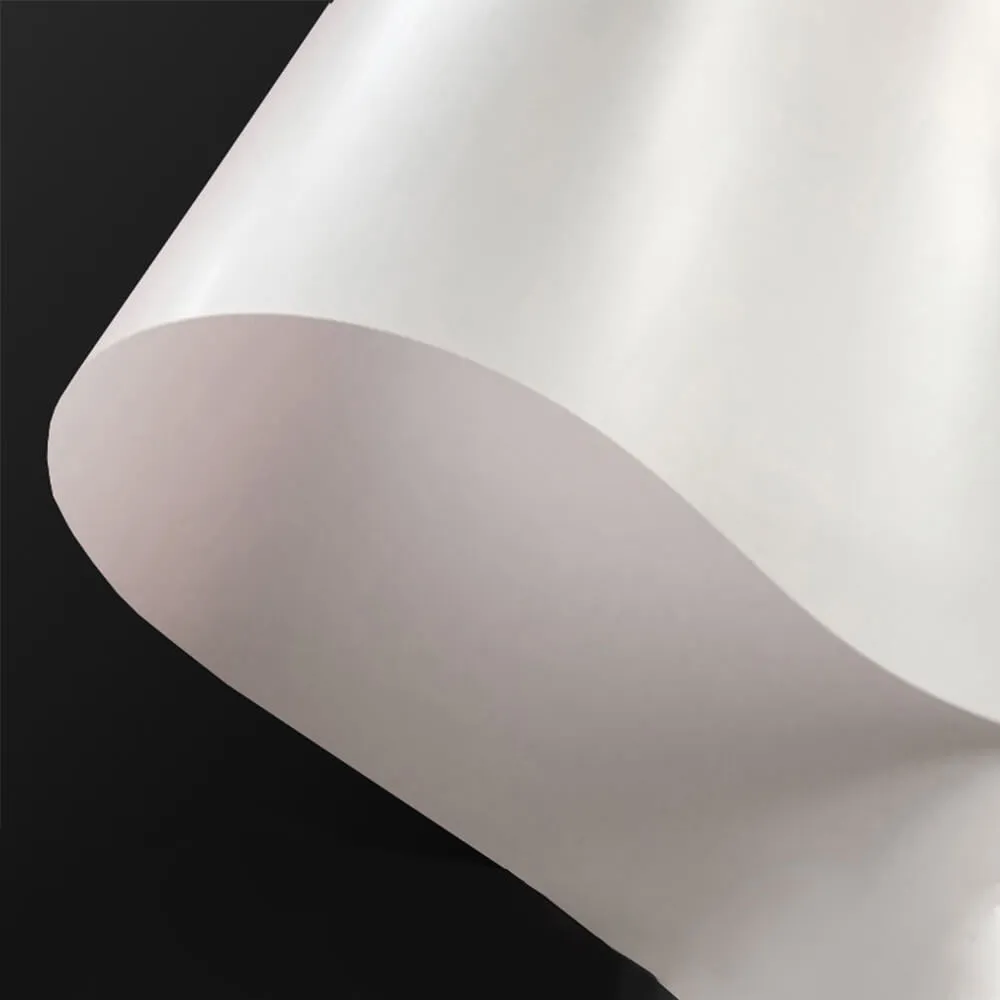
Kaixin diffusion film is a functional optical film material designed to control light transmittance, haze and diffusion uniformity in display and backlight systems. It is widely used in LCD backlight modules, touch panels, automotive displays, electronic labels and smart home appliance panels.
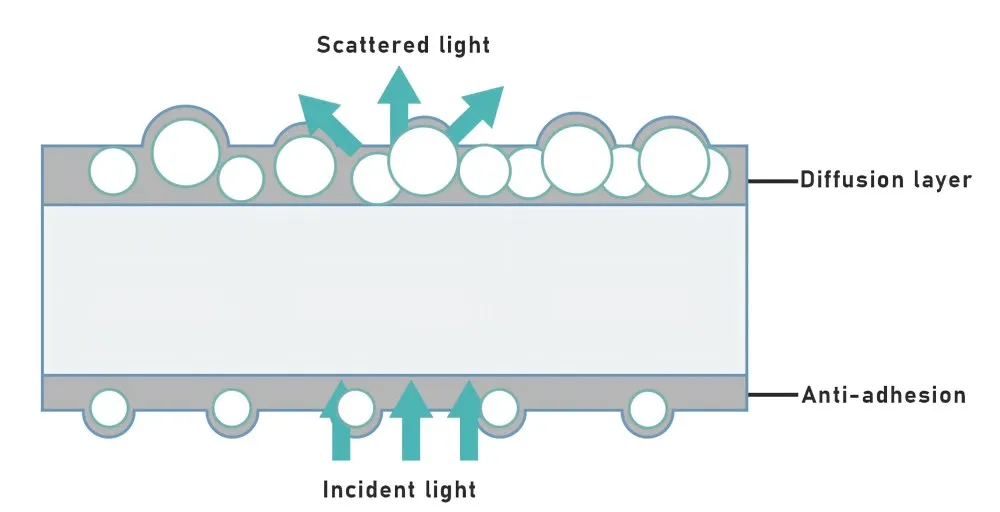
The film works by uniformly distributing micron-scale diffusion particles with high refractive index onto transparent PET or PC substrates. When incident light passes through the diffusion layer, it undergoes multiple scattering inside the film structure. This process helps homogenize light distribution, expand the light output angle and improve visual uniformity.
Brightness uniformity: Helps create more even light distribution across the display area.
Hotspot reduction: Reduces localized over-bright regions in backlight modules.
Moiré suppression: Helps minimize visible interference patterns in display structures.
Custom optical control: Supports diffusion particle sizes from 2μm to 7μm and haze levels from 20% to 80%.
Product Structure and Advantages
Kaixin diffusion films are typically manufactured using multi-layer co-extrusion or functional coating processes. The film structure can be adjusted according to optical performance, processing requirements and end-use environments.
Substrate Layer
The substrate layer uses high-clarity PET or PC film as the base material. The typical thickness range is 50μm to 250μm. It provides optical clarity, dimensional stability and thermal stability for display and backlight module applications.
Diffusion Layer
The diffusion layer is composed of high refractive index diffusion particles such as PMMA or SiO₂ combined with specialty resin systems. Particle size distribution and surface haze are precisely controlled to achieve stable and uniform light diffusion.
Optional Functional Layers
Optional surface treatments can be applied according to application needs, including hard coating, scratch resistance and anti-fingerprint treatment. These functional layers help improve durability, process compatibility and long-term use reliability.
KX07 and KX08 Series Diffusion Film
The Kaixin KX07 and KX08 Series diffusion films offer both PET and PC high-performance substrate options, supporting different requirements for optical performance, environmental resistance, processability and cost control.
These series are suitable for display backlight modules and optical components that require stable haze, controlled transmittance, uniform light diffusion and reliable film processing.
Customers can select the suitable substrate type, haze level and thickness according to the display structure, brightness requirement, operating environment and final application scenario.
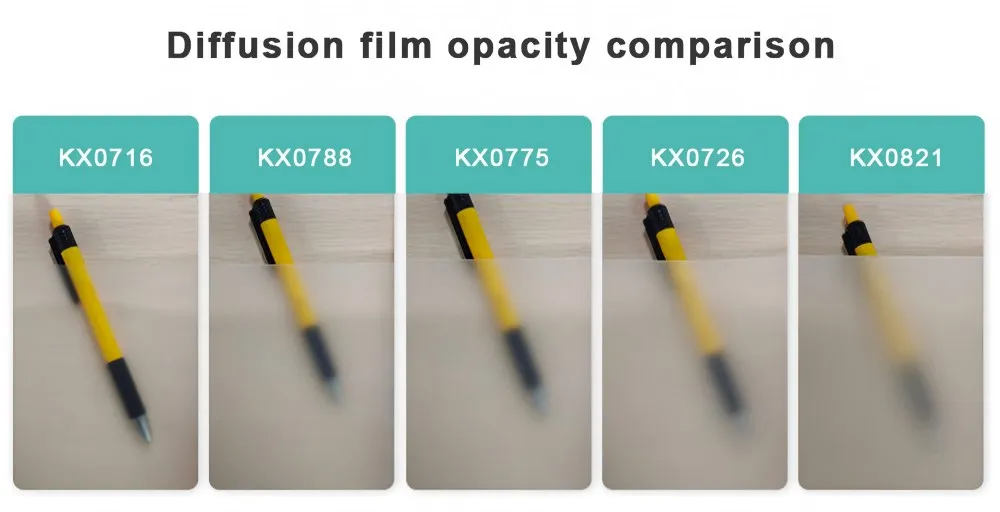
PET Based Diffusion Film
PET based diffusion film is designed for applications that require high light transmittance, stable thickness control and cost-effective mass production. It is particularly suitable for moderate-to-low haze requirements where clear image display, slim module design and processing efficiency are important.
With good processability, PET diffusion film supports die-cutting and laminating compatibility, making it a practical choice for high-volume consumer electronics, appliance panels and general display backlight modules.
Typical Applications
PC Based Diffusion Film
PC based diffusion film is designed for demanding applications that require wider temperature resistance, stronger impact toughness and better dimensional stability.
With a broad temperature resistance range from -40°C to 125°C, PC diffusion film is suitable for automotive displays, medical terminals, premium industrial control displays and display modules exposed to outdoor or extreme temperature conditions.
The film also supports surface treatments such as hard coating, scratch resistance and anti-fingerprint coating. With an extended haze control range from 20% to 80%, PC diffusion film can provide stable light diffusion uniformity while supporting integration into structural display components.
Primary Applications
Products Advantages
Kaixin diffusion film combines optical performance, environmental reliability and processing flexibility for display and backlight applications.
Comparison of PET and PC Diffusion Films
PET diffusion film is optimized for consumer electronics and appliance panels requiring high-definition imaging, slim profiles, high transmittance and cost efficiency.
PC diffusion film is designed for high-stress environments requiring better temperature resistance, higher structural durability and broader haze control, with automotive displays as a key application area.
| Comparison Item | PET Diffusion Film | PC Diffusion Film |
|---|---|---|
| Main Positioning | Cost-effective optical diffusion film for consumer electronics and appliance panels. | High-durability diffusion film for automotive, medical, industrial and harsh-environment displays. |
| Key Strengths | High light transmittance, good processability and stable thickness control. | Wide temperature resistance, impact toughness and dimensional stability. |
| Haze Requirement | Suitable for moderate-to-low haze applications. | Suitable for broader haze control, including higher haze applications. |
| Processing Suitability | Easy die-cutting and laminating compatibility for high-volume production. | Suitable for structural integration and demanding module assembly. |
| Typical Applications | LCD TVs, monitors, tablets, e-readers, smart speakers and appliance panels. | Automotive displays, HUD backlight layers, medical terminals, industrial displays and outdoor modules. |
Applications of Diffusion Film
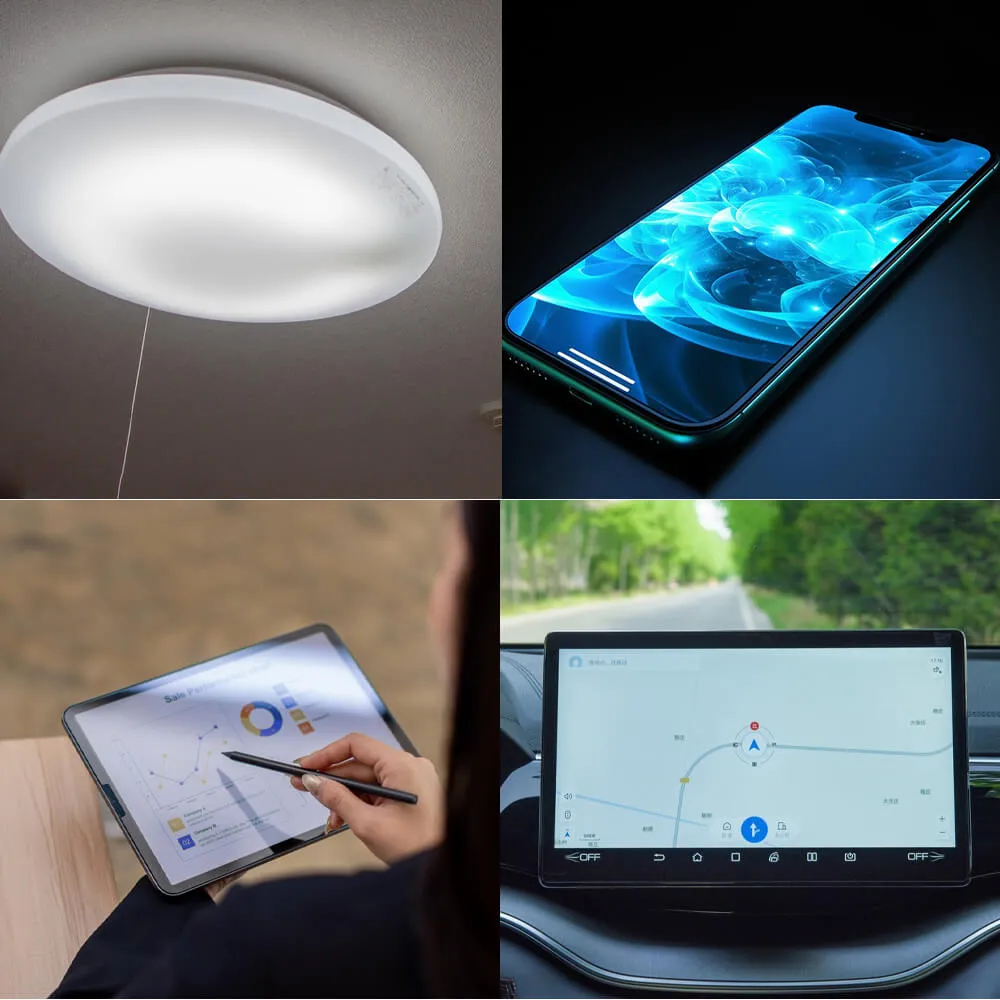
Kaixin diffusion films are used in display and optical modules where brightness uniformity, visual comfort, stable haze and reliable processing are required.
Automotive Display Systems
Automotive displays frequently operate in high-brightness or strong ambient light environments. High-haze diffusion films can help expand viewing angles, reduce glare and improve display readability. Combined with hard coat anti-scratch treatment, they support better durability and safety in vehicle environments.
Consumer Electronics Displays
In smartphones, tablets, e-readers and smart speaker screens, low-haze diffusion films help maintain image clarity and color accuracy while preventing localized over-brightness, brightness non-uniformity and Moiré patterns.
Home Appliance and Industrial Control Panels
For washing machines, air conditioners, medical terminal equipment and industrial control interfaces, Kaixin diffusion films provide temperature resistance, matte surface appearance and improved readability under different lighting conditions. Optional scratch-resistant and anti-fingerprint treatments help extend product service life.
Technical Advantages
Kaixin supports stable diffusion film production through in-house coating, precision calendering and slitting production lines. Film thickness uniformity, particle dispersion and surface flatness are carefully controlled to support stable master roll production and reliable delivery.
High uniformity coating process: Precision-controlled coating helps reduce particle aggregation and cloudiness, supporting stable optical consistency.
Customizable optical parameters: Thickness, haze, transmittance and substrate type can be adjusted according to cross-industry display and optical module requirements.
Superior environmental resistance: PC-based diffusion films maintain stable physical properties under demanding temperature conditions from -40°C to 125°C.
Eco-compliant product options: Products can meet RoHS, REACH and halogen-free requirements for global display and electronics customers.
Stable production capability: In-house coating, precision calendering and slitting lines support thickness uniformity, particle dispersion, surface flatness and stable master roll production.
R&D and Service Support
Kaixin operates a dedicated LCD production division that extensively uses diffusion films in liquid crystal display module manufacturing. This integrated structure provides real-world application feedback for product optimization and enables rapid validation of optical properties, compatibility and reliability during R&D.
Testing and Validation Capabilities
Haze and Transmittance Testing
Optical haze and transmittance can be tested by haze meter to support product selection and validation.
Adhesion Testing
90° peel strength testing helps evaluate coating adhesion and processing compatibility.
Thermal Cycling Tests
Thermal cycling from -40°C to 125°C supports reliability evaluation for demanding display applications.
Abrasion and Scratch Resistance Testing
Surface durability can be evaluated for applications requiring hard coating, scratch resistance or frequent touch interaction.
Application Engineering Support
What is diffusion film used for in LCD backlight modules?
Diffusion film is used to improve brightness uniformity, reduce localized hotspots, expand the light distribution angle, and help minimize Moiré interference in LCD backlight modules. It works by scattering incident light through micron-scale diffusion particles distributed on a transparent PET or PC substrate.
What is the difference between PET diffusion film and PC diffusion film?
PET diffusion film is typically selected for consumer electronics, appliance panels, monitors, tablets, and cost-sensitive display applications that require high transmittance and good processability. PC diffusion film is more suitable for automotive displays, medical terminals, industrial control displays, and harsh environments where higher impact toughness, dimensional stability, and wider temperature resistance are required.
How do I choose the right haze level for a diffusion film?
The suitable haze level depends on the display structure, LED spacing, brightness target, viewing angle requirement, and acceptable light loss. Lower haze is usually used when image clarity and transmittance are more important, while higher haze is used when stronger light diffusion, hotspot reduction, and glare control are required. Kaixin can support haze customization from 20% to 80% according to application requirements.
Can Kaixin customize diffusion film thickness and optical performance?
Yes. Kaixin can customize substrate type, film thickness, haze level, transmittance, diffusion particle size, and surface treatment according to the customer’s display module design. The typical thickness range is 50μm to 250μm, and diffusion particle sizes can be adjusted from 2μm to 7μm.
Is PC diffusion film suitable for automotive displays?
Yes. PC diffusion film is suitable for automotive center console displays, instrument clusters, rear-seat entertainment systems, and HUD backlight diffusion layers. It offers wide temperature resistance from -40°C to 125°C, good impact toughness, and stable dimensional performance for demanding automotive display environments.
Can diffusion film help reduce hotspots and uneven brightness?
Yes. Diffusion film helps redistribute light through multiple scattering inside the diffusion layer. This improves spatial light uniformity, reduces localized over-bright areas, and supports more consistent brightness across the display surface.
Does Kaixin diffusion film support hard coating or anti-fingerprint treatment?
Yes. Depending on the application, Kaixin can provide optional functional surface treatments such as hard coating, scratch-resistant coating, and anti-fingerprint coating. These treatments are commonly considered for automotive displays, touch panels, industrial control interfaces, and other high-touch applications.
What information should I provide before requesting diffusion film samples?
To recommend a suitable diffusion film, please provide the substrate preference, required thickness, haze target, transmittance requirement, display structure, LED spacing, application field, operating temperature range, surface treatment requirement, and sample size or roll size. If the final specification is not fixed yet, Kaixin can assist with material selection and sample development.
Are Kaixin diffusion films compliant with RoHS and REACH requirements?
Kaixin diffusion film options can comply with RoHS, REACH, and halogen-free requirements. For regulated applications or customer-specific compliance documentation, please confirm the target product series, substrate, coating structure, and destination market before order confirmation.
Does Kaixin provide testing and application engineering support?
Yes. Kaixin supports haze and transmittance testing, adhesion testing, thermal cycling tests, abrasion and scratch resistance testing, custom sample development, structural design consultation, and collaborative application engineering. This helps customers validate optical properties, processing compatibility, and reliability before mass production.
Request a Diffusion Film Recommendation
Need help selecting the right optical diffusion film for your LCD backlight module, automotive display, consumer electronics panel, or industrial control display? Share your required substrate, film thickness, haze target, transmittance requirement, operating temperature range, surface treatment needs, roll size, and application field. Kaixin can recommend a suitable PET or PC diffusion film configuration based on your optical and processing requirements.