
Pre-cured Film Solutions for Functional Plastic Applications
Kaixin provides pre-cured functional film solutions for automotive, electronics and industrial applications, combining engineering plastic films with functional surface coating technologies to meet demanding requirements for appearance, durability and forming performance.
By curing the functional coating during film manufacturing, pre-cured film eliminates the need for secondary curing after forming, helping simplify downstream processing, reduce process variability and maintain more consistent surface quality.
With capabilities in polymer films, functional coatings, material customization and processing support, Kaixin works with customers from material selection and forming evaluation through project validation and mass-production introduction.
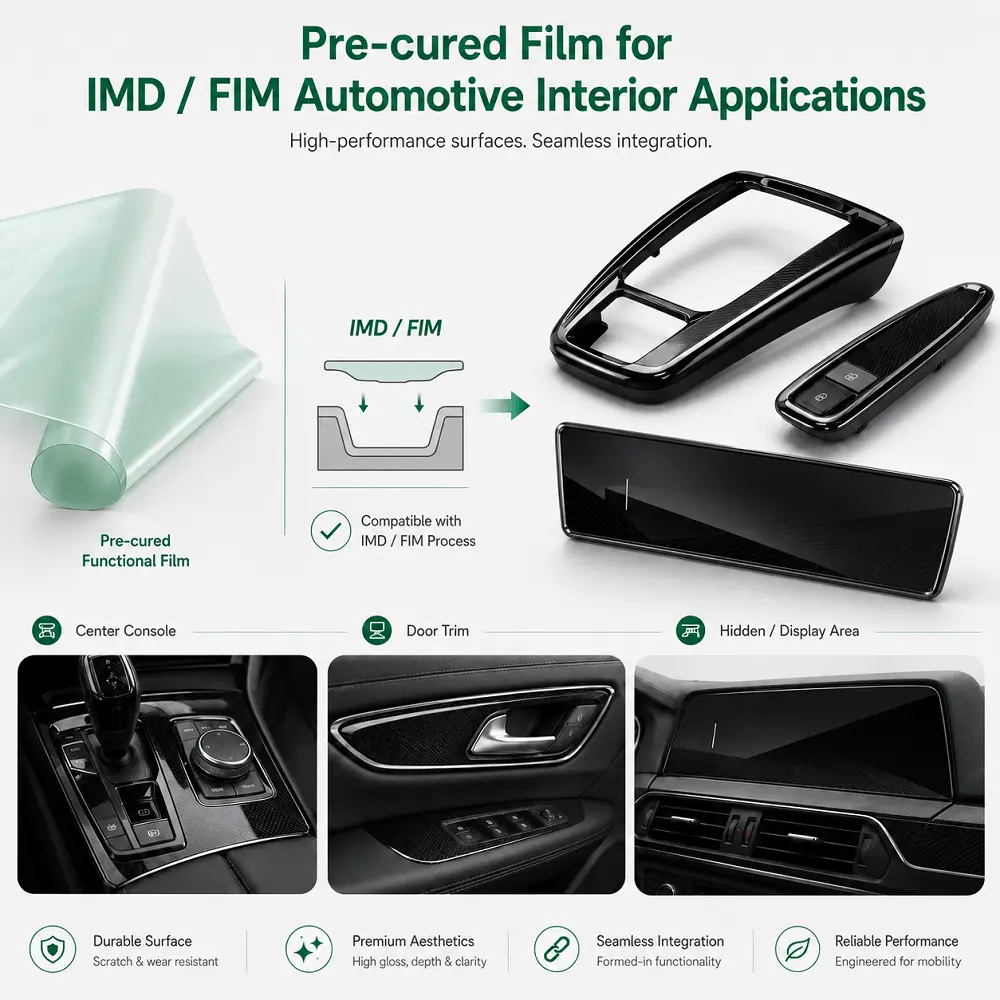
What Is Pre-cured Film?
Pre-cured film is a functional plastic film whose surface coating has already been fully cured before the film enters downstream processes such as printing, forming and injection molding.
Unlike after-cure film, which requires an additional curing step after forming, pre-cured film is designed to maintain its functional surface throughout forming and molding without requiring secondary curing afterward.
By moving the coating-curing process upstream to the film manufacturing stage, pre-cured film can help simplify downstream processing, reduce process variables and improve consistency in surface appearance and functional performance.
This process route is particularly suitable for applications that require both complex forming capability and stable surface performance.
Advantages of Pre-cured Film Technology
Pre-cured functional films combine durable surface performance with forming compatibility, helping simplify downstream manufacturing while supporting premium appearance and functional surface requirements.
Improved Surface Performance
Pre-cured films provide a durable and consistent functional surface before the film enters forming and molding processes.
- Scratch resistance for high-touch surfaces
- Wear resistance for long-term appearance retention
- Chemical resistance for routine cleaning and wiping
- Consistent gloss, clarity and visual quality
- Optional AG, AR and AF surface functions
Better Manufacturing Stability
Because the functional coating is already cured during film manufacturing, fewer downstream processing variables need to be controlled.
- No additional curing step after forming
- Reduced downstream process variability
- More consistent surface quality from part to part
- Simplified manufacturing flow
- Better suitability for stable mass production
Flexible Design Possibilities
Pre-cured functional films can integrate decorative, optical and surface functions directly into molded plastic components.
- Decorative patterns and backside printing
- High-gloss and piano-black finishes
- Transparent and translucent display windows
- Dead-front and hidden-icon designs
- Complex 3D geometries and curved surfaces
Efficient Integration with IMD / FIM Processes
Pre-cured films can be matched to different forming and molding conditions according to the geometry and process requirements of the final component.
- Film Insert Molding (FIM)
- In-Mold Decoration (IMD)
- Thermoforming
- High-Pressure Forming
- Injection Molding
- Screen Printing
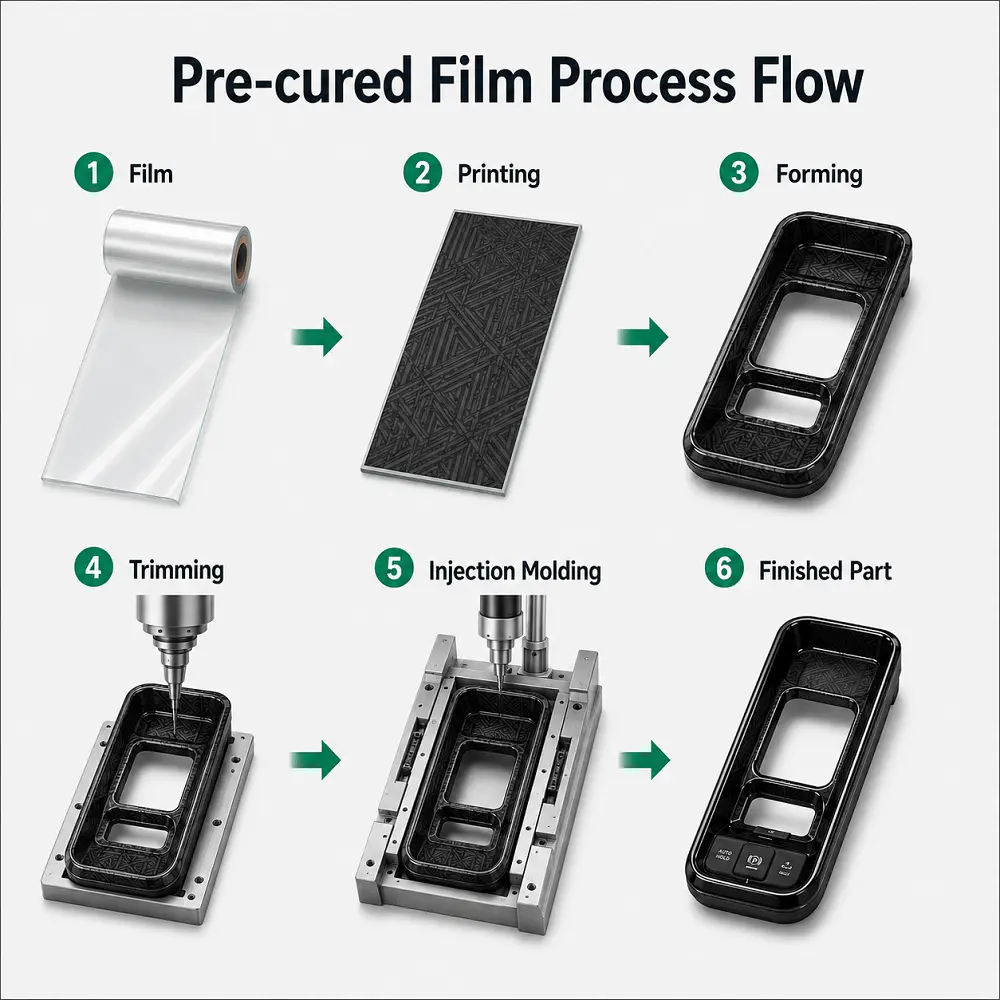
Typical Pre-cured Film Process Flow
Pre-cured film can move directly into downstream decoration, forming and molding processes because the functional surface coating has already been cured during film manufacturing. A typical process route includes the following steps.
Pre-cured Film
Functional film with the required substrate, surface coating and thickness is selected according to the final application and forming requirements.
Printing
Decorative graphics, patterns, light-blocking layers or functional inks can be applied, typically on the reverse side of the film.
Forming
The printed film is thermoformed or high-pressure formed into the required three-dimensional geometry.
Trimming
The formed film is precisely trimmed to match the final component shape and molding requirements.
Injection Molding
The formed film insert is placed into the mold and integrated with the plastic substrate during injection molding.
Finished Part
The finished component combines the molded structure, decorative design and pre-cured functional surface in one integrated part.
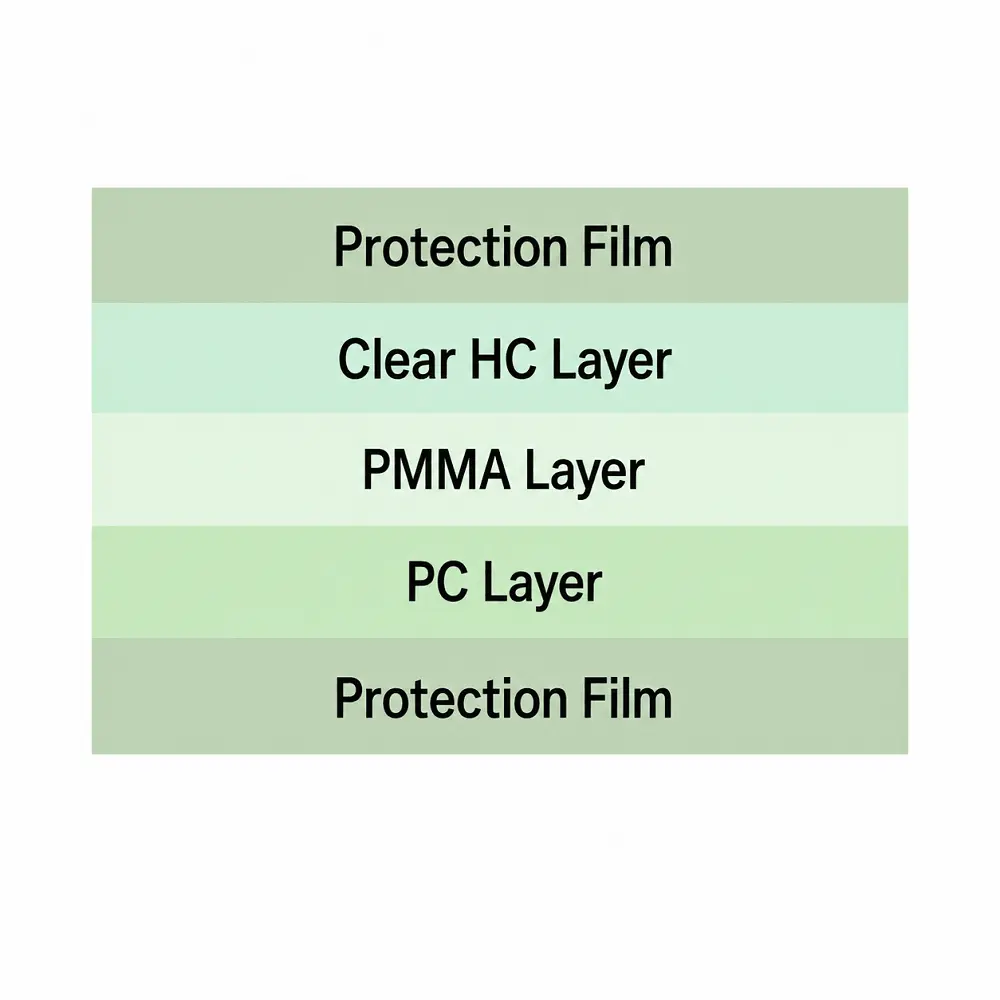
Pre-cured Film Structure
Kaixin’s standard pre-cured film structure combines a clear hard-coat surface with a PC/PMMA composite film, with protective films applied on both sides for handling and downstream processing.
Standard PC/PMMA Composite Structure
The hard-coat layer provides the required surface protection and functional performance, while the PC/PMMA composite structure balances surface appearance, rigidity and forming capability.
Optional Functional Surface Treatments
Additional surface functions can be developed according to project requirements, including:
The final structure can be matched according to substrate, thickness, optical requirements, forming conditions and end-use performance targets.
Key Performance Reference
The following performance data provide a reference for KXFHC-PCM pre-cured film across different thickness specifications. Final material selection should be based on part geometry, forming depth, appearance requirements, backlight design and subsequent injection molding conditions.
Customers are recommended to complete validation using the actual mold, printing system and process window before mass production.
| Item | KXFHC-PCM/175G | KXFHC-PCM/250G | KXFHC-PCM/380G |
|---|---|---|---|
| Film Thickness | 175 μm ±10% | 250 μm ±8% | 380 μm ±8% |
| Unidirectional Elongation (135°C) | +200–250% | +200–250% | +200–250% |
| High Temperature / High Humidity | 72 h at 85°C / 85% RH No adhesion loss or obvious change |
Same as left | Same as left |
| Thermal Aging | 240 h at 90°C No adhesion loss or obvious change |
Same as left | Same as left |
| Abrasion Resistance | CS10F wheel, 500 g, 200 cycles <15.0% haze change |
Same as left | Same as left |
| Ethanol Resistance | No change after 30 min at 20°C | No change | No change |
| Optical Performance | Haze <1.0% Total light transmittance ≥90% |
Same as left | Same as left |
| Pencil Hardness (750 g) | H–2H | 2H | 2H |
| Water Contact Angle | ≥100° | ≥100° | ≥100° |
Automotive-Related Validation References
The material has also been evaluated using automotive-related exposure and aging test methods. These results provide supporting reference data for customers conducting further application-specific qualification.
| Test Standard | Condition | Result |
|---|---|---|
| SAE J2412 – Accelerated Exposure of Automotive Interior Trim Components Using a Controlled Irradiance Xenon-Arc Apparatus | 225 KJ | Pass |
| VW PV1303 – Exposure Test for Non-Metallic Passenger Compartment Components | 6 cycles | Pass |
| DIN 75220 – Aging of Automotive Components in Solar Simulation Units | 240 h | Pass |
Applications of Pre-cured Film
Pre-cured functional films can be adapted to a range of molded plastic applications where surface protection, appearance quality and forming compatibility are required. Material structure, coating function and processing conditions can be matched according to the requirements of each project.
Automotive Interior Components
Pre-cured films can be used for automotive interior decorative and functional components requiring stable surface appearance, forming capability and resistance to daily wear and cleaning.
- Center consoles
- Decorative trim
- Control panels
- Display windows
- Hidden-icon areas
Consumer Electronics
Suitable for molded electronic components requiring integrated decoration, optical appearance and surface protection.
- Display covers
- Control interfaces
- Decorative housings
- Touch surfaces
Home Appliance Panels
Pre-cured functional films can support decorative and functional surfaces for appliance control panels and integrated display areas.
- Control panels
- Display windows
- Decorative surfaces
- Touch interfaces
Industrial Components
Suitable for industrial plastic components requiring durable decorative surfaces, clear interfaces and stable processing performance.
- Operator panels
- Equipment interfaces
- Functional covers
- Decorative molded parts
Pre-cured Film vs After-cure Process
Pre-cured and after-cure films use different curing strategies to meet different forming and surface-performance requirements. The key difference lies in when the functional coating is finally cured during the manufacturing process.
In a pre-cured film process, the functional coating is already cured during film manufacturing, allowing the film to proceed through printing, forming and injection molding without an additional curing step after forming. In an after-cure process, final curing is completed after the film has been formed into its three-dimensional shape.
The appropriate process route depends on part geometry, forming conditions, required surface performance and the customer’s established production process.
| Comparison Item | Pre-cured Film | After-cure Film |
|---|---|---|
| Coating Condition | Functional coating is already cured before forming. | Final curing is completed after forming. |
| Typical Process | Film → Printing → Forming → Trimming → Injection Molding → Finished Part | Film → Printing → Forming → UV Curing → Trimming → Injection Molding → Finished Part |
| UV Curing After Forming | Not required. | Required. |
| Process Complexity | Fewer downstream processing steps. | Includes an additional curing step and related process control. |
| Process Variables | Fewer variables need to be controlled in downstream production. | Additional curing conditions must be controlled. |
| Surface Consistency | Designed to maintain stable surface appearance through forming and molding. | Final surface condition also depends on the secondary curing process. |
| Production Integration | Well suited to continuous IMD / FIM production. | Requires integration of an additional curing process. |
| Best Fit | Applications prioritizing simplified downstream processing, stable surface quality and mass-production consistency. | Applications where post-forming curing is already part of the established process route. |
Technical Capabilities
Kaixin combines engineering film materials, functional coating technologies and precision converting capabilities to support pre-cured film projects from material selection and surface-function development to customized processing and project implementation.
Film Materials
Engineering film platforms can be selected according to optical, decorative, forming and functional requirements.
- PC Film
- PET Film
- PMMA Film
- PC / PMMA Composite Film
Functional Coating Technologies
Surface functions can be developed according to required optical appearance, durability and end-use performance.
- Hard Coating
- Anti-Fingerprint (AF)
- Anti-Glare (AG)
- Anti-Reflection (AR)
- Customized Functional Coatings
Precision Processing Support
Converting and customization services help prepare materials for downstream printing, forming and molding processes.
- Precision Slitting
- Film Lamination
- Custom Width & Size
- Project Customization
Custom Pre-cured Film Development and Project Support
Pre-cured film projects often require coordinated selection of substrate, coating function, thickness and downstream process conditions. Kaixin works with customers to evaluate these variables and develop a material solution matched to the actual forming and molding process.
Key Project Parameters
Typical Development Workflow
Application Review
Review the final component, appearance targets and functional requirements.
Material Selection
Select the appropriate substrate, film thickness and base structure.
Coating and Structure Matching
Match hard-coat and optional functional surface treatments to the project requirements.
Sample Evaluation
Prepare samples for appearance, forming and processing evaluation.
Forming and Molding Validation
Validate printing, forming and injection molding compatibility using the actual process window.
Mass Production Introduction
Finalize the material specification and support stable production introduction after validation.
Why Choose Kaixin for Pre-cured Film Solutions?
Kaixin combines engineering film materials, functional coating technologies and application-oriented project support to help customers develop reliable pre-cured film solutions for demanding plastic applications.
From material selection and surface-function development to forming compatibility, precision processing and project validation, Kaixin supports customers throughout the development process toward stable production introduction.
Integrated Film and Coating Expertise
Kaixin combines engineering plastic films with hard coating and optional AG, AR, AF and other functional surface technologies, allowing material structure and surface performance to be developed as one integrated solution.
Application-Oriented Material Development
Material thickness, substrate structure, optical performance and coating functions can be matched according to forming geometry, appearance requirements and downstream processing conditions.
Precision Processing Support
Precision slitting, lamination and customized size preparation help customers integrate film materials more efficiently into printing, forming and molding processes.
Project Validation for Mass Production
Kaixin supports sample evaluation, forming compatibility checks and process validation before mass production, helping reduce project uncertainty and improve production consistency.
Pre-cured Film FAQs
Common questions about pre-cured film structure, IMD/FIM compatibility, material selection, surface functions and project validation.
What is pre-cured film?
Pre-cured film is a functional plastic film whose surface coating has already been cured before downstream processes such as printing, forming and injection molding.
Because the coating is cured during film manufacturing, the film can proceed through forming and molding without requiring an additional curing step afterward.
What is the difference between pre-cured film and after-cure film?
The main difference is the curing stage. Pre-cured film is cured before forming, while after-cure film requires final curing after the film has been formed into its three-dimensional shape.
The appropriate process depends on part geometry, forming conditions, required surface performance and the customer's established production route.
What materials are available for pre-cured functional films?
Kaixin can develop pre-cured film solutions based on engineering plastic films such as PC, PET, PMMA and PC/PMMA composite structures.
Material selection depends on optical requirements, forming performance, mechanical properties and the required surface function of the final application.
Is pre-cured film compatible with IMD and FIM processes?
Yes. Pre-cured functional films can be designed for Film Insert Molding (FIM), In-Mold Decoration (IMD), thermoforming, high-pressure forming and injection molding processes.
The material should be matched according to forming depth, corner radius, draw ratio, printing system and injection molding conditions.
What factors should be considered when selecting a pre-cured film?
Key selection factors include substrate material, film thickness, coating function, gloss, haze, light transmittance, forming depth, corner radius, draw ratio, printing system and injection molding conditions.
For new projects, validation using the actual mold and processing window is recommended before mass production.
Can AG, AR and AF functions be integrated into pre-cured film?
Yes. Depending on project requirements, Anti-Glare (AG), Anti-Reflection (AR), Anti-Fingerprint (AF) and other customized functional coatings can be developed on the pre-cured film platform.
The final coating combination should be matched to the substrate, forming requirements, optical targets and final application.
Does Kaixin provide customized pre-cured film solutions?
Yes. Kaixin can support material selection, coating and structure matching, sample evaluation, forming compatibility and project validation.
The development process can be matched to customer requirements for appearance, optical performance, surface durability and downstream processing before mass-production introduction.
Request a Pre-cured Film Solution
Tell us about your application, material requirements and processing conditions. Kaixin can help evaluate the appropriate pre-cured film structure, coating function and thickness for your project.
For a faster technical review and quotation, please include details such as the application, film thickness, surface function, forming process and estimated quantity.